DOROTHY DELILA HICKMAN PECTOL
From the Butcher/Hickman web site
Our Beloved Mother and Grandmother,
compiled by her daughter: Golda Pectol Busk


 "Dorothy Hickman’s History Begins 30 March, 1880 through 1950:
Uncle Jimmy (James) Hickman, my father's uncle, known all over to those in sickness and distress.
It was a hard struggle for them the winter of '79. My father had no work this winter. The only means of support was with the one horse he had which was used for dragging wood, selling it or trading it to those in better circumstances. I also learned from my parents that the mines were not running that winter and they were too proud to complain. My father told me the only shoes he had were picked from the trash piles and were often odd sizes and kinds, but they were happy with their babies, my sister Berley and brother, Will. Will was sick all winter from improper diet which consisted mostly of beans. Even with all these hardships they were happy in the love they shared with each other.
Lights called "bitches" were made by putting a little tallow in a saucer, then twisting a rag to form a sort of wick which was dipped into the tallow. This was all the light they had to use when darkness came. These were crude candles as we would call them today.
When spring came after I was born; my parents decided to move farther south as some of their family had gone on earlier to a place called Horse Shoe Bend tow mile south of Milford, Utah. A mining district had opened up in a place called "P Star" east of Milford and one west called Shaunti. By securing another horse, and by trading and picking up enough pieced to put a wagon together, they started for Horse Shoe Bend. By this time I was three months old. Will was much better, and of course, Berley grew up as first children always do. Father and mother claim I cried all the way to Milford each taking turns walking me because I would not ride in the wagon. I have no cause to disbelieve them. The drives were not long in a day, as the horses were too poor, and there was very little feed. We lived in a hut there. I think it could also be called a dug-out. My father worked at the above named mines for awhile. The ore was hauled by wagons and mostly mule teams, put on the train at Milford and shipped to smelters in the northern part of the State. After awhile a smeltering process was started in Milford, but was not much of a success.
Our stay was of short duration at Horses Shoe Bend. We moved into Milford and were fortunate enough to own a home with three rooms. It was in Milford that Sadie, George, Joe, Don, Vivian, and Myrtle were born.
While living in Milford my father guarded gold and silver bullion sent from Delmar to Milford. Three span of horses attached to a light coach was used to haul it. From the coach it was put on the train and sent to Salt Lake City. I was about eight years old and well remember the fear my mother and we children went through each trip he made. The fear was of highway robbers and bandits trying to steal the valuable ore being hauled to the train. My father had no fear, and was never but once molested and that was on the train. The robbers became frightened and jumped. It was never known who they were, or if in the jump they were killed.

Previous to the time the railroad was established in Pioche, Nevada, my father, Will and John Kirk freighted goods from Milford to Pioche using four to six span of horses on a single, or two, wagons coupled together. The time of travel between towns would be about two weeks to go to St. George, Las Vegas and Pioche. He also owned a livery stable at Milford. It was at the livery stable he became acquainted with a freighter from Elsinore named John Busk. This acquainted amounted to nothing materially or socially at that time, but years later one of his sons married my daughter, Golda, and he spoke of knowing Hickman, often accepting his hospitality at the livery stable.
Up until the time I was six years of age and started to school, the time passed with nothing of importance to my memory. My school days were spent in Milford. I finished the eighth grade which ended my schooling when I was sixteen. The year I finished, I taught the smaller grades in the same building, a room about 20 x 40 feet long, under the head teacher, Miss. Christensen, for $25.00 per month and two music lessons a week.
At the time I finished my schooling, we were living on a little ranch about one half mile from town and we children walked to school and ate a bucket lunch. One time when I was about eight years old, I remember a boy teasing me and calling to me: "Dot is a monkey, Dot is a monkey" at which I became very angry. I threw a stove poker at him and almost cut his lip. I was frightened, but it taught him and others a lesson. They never bothered me again.
At school, of course, we always have our little love affairs, so I had mine. I was about ten at this time. The school teachers had chosen for us a partner for the school party. I wanted my sister Berley's beau. It seemed all through my childhood and girlhood days I fell for my sister's beaus. When she got ready to go home, I left my beau (or date) John Wright, and ran after her. When I became twelve years old, this young man, her beau, turned out to be my brother-in-law, John Kirk! At a Thanksgiving dinner at our house before he and Berley were married, he saw me crying and said, "Dottie, if you won't cry I'll give you a nickel." Little did he dream I was crying because he had asked my sister to go to the dance with him instead of me.
One night about 10 p.m. my father had come home from delivering bullion. Mother had just fixed his supper and he was eating. We children were all in bed. The kitchen door opened without a knock and in walked the largest person we could ever imagine seeing. He was all feathered, blanketed, and painted up. We were all petrified at seeing this intruder, an Indian. We shouldn't have been frightened for he was from a friendly band of Indians who worked to earn their living. He told my parents that all he wanted was food. He didn't get any, but went out of the house in front of my father's foot. We were never bothered again by him or any other Indian. Many of the squaws washed clothing all day for fifty cents.

Berley was growing up. She was too much of a lady at this time to help Will and me hatch the twelve eggs mother had setting under the only hen she had. What a fiasco this turned out to be! Mother had purchased these eggs with money she had saved for a long time, and was waiting, patiently for them to hatch. We helped the old hen hatch those eggs, alright. We didn't realize they weren't smothering. How were we to know that was the natural way baby chicks came into this world. They all died, of course. We knew, soon after our midwifery what a disappointing experience this was for our mother. She had intended to use those chickens to help feed HER little flock. If she ever knew what we did, she didn't scold us. This ended our interest in ever assisting any more barnyard residents. However, there was a time we shared another kind of experience. One time when we were living in Grover, Utah, mother left Will and me to tend our little brother Joe. We grumbled about this as most all children do when they are entrusted with younger siblings. We fed little Joe lamb droppings and told him they were pine nuts. It didn't make him sick. We were the sick ones when we realized what an awful thing we had done to an innocent child because we didn't want to tend him.
After this let-down, I was soon ready for more excitement. Romance or any new experience thrilled my pink. It was with happy anticipation that my parents decided to make a hurried trip to Caineville, Utah to visit my mother's parents who lived there. I was twelve years old and had a merry time with my cousins, new faces, new hills to climb, new people to meet. I did see someone new, a boy who took my fancy, and who was to be by future husband, but of course he did not notice me...only my sister Berley. I was still somewhat of a tomboy and a giggly girl, not as sophisticated as she. We stayed a short time and returned to Milford living in the same house about one half mile from town. It was upon our return that I once again met my king of kings! This time it was Charlie Cook. He took me to private dances, and how the other girls envied me as he was a new comer in town, and a school teacher. One night a girl with red hair came to town, and I was...no more his date. I was just sixteen, and still pug-nosed and my hair just wouldn't stay put up like the older girls. My, how unhappy a girl can be at that age when she thinks she is in love and he marries someone else. Yes, he married this girl just two days after he met her. In a few months he became tired of his red head and wanted me, but my parents soon put a stop to that.
For my sixteenth birthday my parents gave me an organ. We moved into town and soon, even at sixteen, I was quite settled and sensible again. I enjoyed going to church and played the organ. Since I could play the organ, I corded for violins making music for dances. Oh, how I loved to dance, too. I never seemed to be lonely for I loved to be with people trying in many ways to make them happy. I enjoyed being with my girl friends and we had many good times together.
In the summer of 1896 we mad another trip to Cainville to visit my grandparents, the William T. Carrells. Just before going into Caineville at the south entrance there is a dugway we called the Blue Dugway, a road following a blue clay hill. As we were ascending the grade a wagon was coming down. The road was both steep and narrow. In trying to pass, the two wagons nearly overturned. As the excitement died down and I got a good glimpse of the lone wagon master, I could see it was the boy who I had wanted to pay attention to me a few years before. He wore a straw hat and looked like someone form heaven setting there in the wagon on a roll of bedding with a box of provisions beside him for he, we learned, was going for a load of lumber. As I looked at him I knew we were meant for each other. He later told me the same thing, for I was no longer the "tom boy" he remembered a few years ago. Don't think I didn't, this time, make a full swing for my beau, for my sister Berley, was out of my way. His name was Ephraim Portman Pectol. (His history is more romantically detailed.)

At the time we were to return to Milford, I became quite sick. There were no doctors around, and my father not being as Elder in the Church yet, wanted someone with the Priesthood to be with us. He felt better having someone along with authority to administer in the name of the Lord. Port, as I and everyone called him, accompanied us home. Oh, the happiness I knew by the time his stay with us was up and he had to return home to Caineville. We both knew of a certainty that the search was over and this love of ours was to be carried into eternity.
My father bought a store in Milford with Ed Sawyer as a partner. We kept the store about a year and a half.
A man by the name of Allred from Deseret, Utah who helped my father with the IXL cattle ranch, proclaimed his love for me to my father and "craved my sincerest attention". This was one of the funniest loves of my life for he was forty-five years older than I. Such an expression of devotion neither I nor my parents had ever heard. I had no thought of him, a man that old, as I had met my choice in Cainville just a year ago.
In the spring of 1897 my father decided to move to Caineville. My brother Will and his wife, Ida, went there to live on the place my father had purchased until he came later that fall. Very definitely, I went with Will and Ida because my heart was there, and so I was happy. There were other boyfriends in Caineville, but none suited me as Port did.
Life in Caineville was a little dull this summer of 1897 after having lived in Milford, but the love Port and I shared for eaach other was growing stronger each day so we did not notice, too much, how the time was dragging. There were good times with other friends here, but none ever measured up to me as Port did. It was on June 10, 1897, a beautiful clear moonlight night he told me, again, of his love and was only waiting for my parents to come to sanction his wish for our marriage. Talking to me with his lips on mine, it seemed I could hardly wait for my parents to come so we could tell them of our plans for the future, and hope they would not object to our life together as we had planned.
In the mean time my parents arrived earlier than they had expected. On a Sunday night a week or so later, in the little orchard my parents owned, he asked them if he might talk plain to me and them, asking that if God and they were willing, I could be his wife. Oh, God, I can feel his lips on mine in the sweet true devotion we had for each other when they, or my father, reluctantly, said that we had better wait for a little while, but go on as we desired loving each other, finding out for sure that we really wanted each other. Perhaps wait two years. TWO YEARS! We promised, but who better than two people who love each other, know the thinness of a promise like that. I felt he was worthy, but perhaps the folks were right, we should wait, but to me he was my Prince and I would not deny that. However, the time was shortened every hour and every day.
In the fall Port taught school in Caineville for a five month school year for $30.00 a month. (In the meantime he had attended school at Snow College in Ephraim, Utah and the Brigham Young Academy in Provo, Utah where he received his formal education.) I taught school in Giles or Blue Valley, where I received $30.00 per month and boarded around at different homes. My education was limited to eighth grade but in those days it qualified me as a teacher. Somehow this winter passed by with us seeing each other only on week ends. Friday nights he would come to Giles for me in an old buckboard wagon hardly good enough to told together drawn by the little old grey mare my father gave him to ride back to Caineville after his stay with us in Milford, hold out the cold, no heater to keep us warm inside, no radio, but we didn't need these conveniences. We were much better off than a number of our friends. We were together and the joy of those cold, cold rides will never be forgotten. The hours between Giles and home were too short. I could hardly wait, and neither could he, for Friday to roll around. Not much education was taught the children on these week end days. In the spring of 1898 his school was out before mine and he went to Hanksville to work for Mr. Charlie Gibbons. My brother, Joe, came for me each Saturday. Although I was glad to be with him, it was not like being with the one I loved.
I did not have much of a fling at Giles. However, a few of the boys thought me "swell" and told me so, only they knew I was Port's girl and respected me as such. One boy, Aust Mayhew did me the honor of naming his beautiful mare colt after me. One time, years later, we met in Salt Lake City. He looked at me and said: "My, Dot, I thought I named my horse after a Beauty. I regret I did so." (He couldn't have been disappointed for Mother was beautiful and still was at seventy-one years of age.)
During the summer and winter of 1898, I commenced working on my trousseau. I just couldn't find enough time in one day to do everything that needed to be done in order to get ready for my wedding. It was such a hurry after school to pick out and send for cloth for the things I would need to make. Mail order catalog were an only source of supply for everything but the food that we supplied ourselves. My sister Berley, who was married and out of my way now, and who lived in Milford, came to help me make quilts, dresses, and as well my Temple garment which was made of unbleached muslin (factory it was called) made from the pattern given to Eliza R. Snow. To make it fit, in the least, was one of the things we only read about today. It had long sleeves and legs, and buttoned down the front. Certainly not the beautiful silk underthings my granddaughters are storing in their cedar chests today, but it was priceless to me. It's significance was my eternal marriage to a worthy husband.
Time seemed to drag on until June 17, 1899. I was 19 and Port 24. After cutting our courting time a year, we with my sister Berley, left Caineville in the early morning in a covered wagon (this could be one of several kinds of wagon) with the same horses that drew out Pumpkin Coach, and commenced our journey to Manti, Utah where we planned to be married in the L.D.S. Temple. No happier couple ever left on such a precious journey. We went to Fruita, Utah the first night, Loa the next day where we bought our marriage license which cost us maybe $1.00, I don't remember. The monetary value of that piece of paper was not on my mind then. Loa was the county seat, and Hans M. Hansen was County Clerk. After much jollying from him we went on to Glenwood where we stayed with Port's Grandparents, the Petersons. In Glenwood this man was referred to as Big Peterson. We went on the next day to Sterling, Utah where we stayed with Port's father's sister, Eunice Pectol Funk. The next morning we were up early and on our way to Manti with much shaking and trembling. This was 21 June 1899, our wedding day! Before going to the Temple we visited with Amy Giles.My dress for going through the Temple was a white lawn trimmed with narrow lace. It had long sleeves tipped to the wrist, and was buttoned down the left side. It was ankle length with a ruffled skirt of gores and a white ribbon sash around the waist. White cotton hose accompanied by white moccasins made from cotton of linen were completed with Temple clothing as worn for this special ceremony. Port's clothes consisted of a white cotton shirt, no tie and Temple clothing as worn now in the Temple.
I can scarcely remember the meeting we went to before our marriage. The time it took to sign the license and get ready to go through the Temple were hours filled with suspense. Finally all was ready, and between twelve and one o'clock, that day, we were kneeling at the alter being sealed for time and all eternity in the House of the Lord by President McCallester. Our witnesses were Ray Hanks, and.....I've forgotten who else.

After our purchases were made, we commenced our journey homeward. Our wedding night was spent under the stars on the ground in Mayfield, Utah. We set up camp about one o'clock in the morning. Frightened? What bride isn't? I had a horror of snakes and didn't get much sleep that night for I was afraid one would get into bed with us. Why should I be frightened, didn't I have my loved one close by me now!
We returned home in the same amount of time it took us to go, and was there ever a gala time in store for us! I remember it well. Our reception, wedding dance and shower was held at my parents' home. My mother and Port's mother had prepared a big dinner for the whole town. There was a wedding cake, chicken, hams and all the trimmings. My dress for this occasion was a two piece blue china silk made like the white one trimmed with white shell trimming. I wore a pair of white kid slippers, pointed toes and squat heels. I was old enough to pin my hair up now, and I fixed it in the latest style. We received seven water buckets, five fire shovels, dishes of all sorts, table cloths, towels and all sorts of things for keeping house. Not expensive gifts as are given now, but prized dearly. (I have the blouse and slippers.)
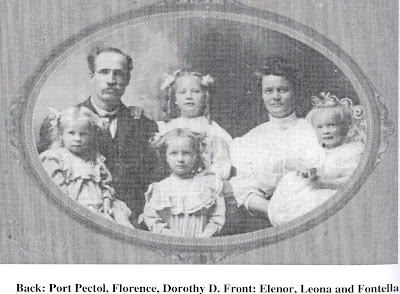
The spring and winter I was getting my trousseau ready, my loved one had purchased a small two room house with a small tract of land north of Caineville. We were so happy in fixing up our palace. Never were a King and Queen more proud and happy than we were. My father had given us a small cook stove which he later replaced with a larger one. We also put, in our home, the organ my parents had given me. the night we arrived from Manti, we stayed in this humble little home. Well I remember before we laid our heads upon our pillows that night, my husband prayed as only one inspired can pray, for God to give up happiness that we might always stay together and that He would bless us with some sweet children to make our lives complete. He asked a special blessing on our home that it would be a haven of peace and rest for us. His prayer was answered throughout our lives and we were blessed by the birth of six sweet daughters; Florence, Leona, Elenor, Fontella, Golda, and Devona. We never had a son of our own so we adopted one, Ephraim Behunin.
It seemed we were never going to be able to settle down to the comfort of our home that night. We were quite unprepared for the reception we received. Our sleep was disturbed by something we felt biting us. The itching would not stop. When Port lit the lamp, the wall seemed to be moving with bed bugs! No more sleep that night. We began right then to fight for their existence or ours. In a short period of time we were rid of these uninvited constant vigil to be sure they were gone, our "Beauty Rest Springfilled" Straw Tick (mattress) really felt good to our bodies for it certainly was a tiring victory for us.
During this time the outlaws of the Robber's Roost were having their hey-day. There was much cattle rustling and stealing by them. Many stockmen went broke and had to leave the country. The Roost gang was feared by everyone. There was quite a bit of mining going on in that part of the country, and those hauling ore to the railroads had some trouble with them. It one know the country between Fruita and Greenriver, Utah, it can be plainly seen why they picked that territory to hide out in. Hanksville, the thriving community it was then, seemed to be just the town they needed to stock up supplies for their next venture. Many a meal I have cooked for these men, and served it, at the Gibbons Hotel where I worked. The one I remember most vividly was Jack Moore and his girl friend of wife. I never did feel comfortable around these people.
In the fall we went to Glenwood where Port worked for his uncle Joseph (Joe) Peterson and we lived with his grandparents, the Petersons. All did not work out too well. In some cases old and young do not mix. We moved ourselves in a little two room house and Port began working for the Singer Sewing Machine company. This did not pay. The fellow he worked for did not pay, so my brother, Joe, came to live with us to help with expenses at this time.
In November 1899 we found out we were to be blessed with our first baby. What a joy this knowledge was to us, but we had no money and no work. We were practically alone, and I think, scared as two kids can be when they realize they are about to assume a new responsibility, especially one of this kind. As time went on and we couldn't find any work, my parents insisted we come to Grover where they had moved from Caineville and await the birth of our child. Oh, how good it seemed to taste my mother's cooking, something else besides BEANS. No, we didn't have all the care, good food and medicine to keep me healthy and provide a good start for our unborn baby. Port worked at odd jobs and what he made we saved for the birth of our baby. His brother Chris had just come home from a mission and needed some help. Port, the epitome of kindness and generosity, gave this money to Chris to buy a stove with for his home. Port knew my parents would take care of us, but I was in tears. (I doubt Grandpa Hickman was too pleased with this gesture.) Florence was born on the 11th of July 1900 at the home of my parents in Grover. Mrs. Heaton, our midwife, worked all day long for us and took care of me and the baby for $5.00. This care was for a ten day period. Port helped in harvesting the alfalfa while we were here.
Florence was two months old when we went back to Caineville to live in our own little home again. Port taught school there that winter for five months for $30.00 per month. We were wealthy, or it seemed, with that little check coming in to help take care of us.

The summer of 1901 he went back to work for Mr. Gibbons again for $25.00 per month. The winter of 1901 and 1902 Port taught school at hanksville, but before the term was up he became very ill with measles and pneumonia. I cannot tell how much we appreciated the people in Hanksville at that time. Everyone was so good, kind and generous to us. By the time spring arrived we were broke. Port was still sick and I had both him and the baby to care for so, my father, who had moved back to Milford, came to Hanksville and insisted on us going back with him. As soon as Port was able, we with his brother Chris, as driver, went to Milford.
We lived with John and Berley. She was very sick at the time, but made us welcome. After Port had rested awhile, my father got him a job in the shearing pens where he dressed the mutton for the cook room shaving off all the fall fat. My mother and I made enough (lye) soap to last both of us many years.
In the summer, 1902 he became so much better. He worked in the store, I baked bread and sold it. I did very well. (I remember how delicious her bread always was.) While my husband was working here he had another attack of pneumonia.
After his recovery we decided to go back to Wayne County. My father purchased a hotel from Tom Blackburn in Loa, Utah. We went there and managed it for him. In the spring, 27 May, 1903 Leona was born here. The midwife for this birth was Mrs. Nelson. My parents decided to move too loa, and took over the hotel management.
This spring, 1903, we were back in Caineville again where Port taught school the term of 1903-4 for the usual pay of $30.00 a month. This winter we saved $75.00 and purchased five head of calves which my brother, Will, took to Grover and kept for us. We lived in our home the summer of 1904 and Port taught school here again for the term 1904-5. We had traded our two room house to my uncle for a much better one. He moved ours a little further to the south. Here our third child, Elenor, was born on the 21 Oct., 1904. Mrs. Noyes assisted with this birth. We stayed in Caineville the summer of 1905. Our living conditions were average. We were in fair circumstances with the money we saved from teaching and the gardening Port and I did in the summers. our crops were mostly fruit, a little hay and truck gardening. I will never forget how good our melons and fruits were for that was our main breakfast food along with a little coarse cereal. Of course, we always had a cow for milk for our children and I made butter and cheese.
Because he had some formal education, was a dedicated experienced teacher with an intense desire for a better educational system and better schools in Wayne County, Port was elected Superintendent of Wayne County Schools in which capacity he served 1905 and 1906.
In the fall of 1905 we moved to Bicknell where my husband taught school that term 1905-6. In the spring of 1906 on March 15, Fontella was born at Bicknell. Mrs. Bullard assisted in this delivery. That spring we moved back to Caineville and continued to fix up and improve the home we had traded for the previous year. We liked it and the location much better than the first home we had. We had finally begun to father some independence around us by hard work and savings. Our field was bearing some alfalfa seed and with Port teaching again in Caineville, but never for more that $30.00 per month, we thought that at last our roots were firmly planted and we were happy in our success.
We had not been put to a test so great as the one which came the summer of 1907 when Port was called on a mission to New Zealand for the Church. I wondered what I would do with four little children, no income except a little fruit and the seed to sell which was only a few hundred pounds. Florence was baptized (I think mother must have meant Florence was not old enough to be baptized, but this is what she wrote), and little Fontella was only fifteen months old. I felt I had more that I could bear, but through hard work, prayer, faith, and the help of God, I was abundantly blessed.
Port left for the Mission home, 1 Aug 1907 expecting a three year Mission. the children, my mother and I, went to Richfield, Utah with him to the train. While there we stopped for a family picture. This was the first time I had seen an automobile. It looked larger than a house to me. My mother was very frightened and we had quite a time persuading her to let us cross the street "for fear it would run after us and catch us and kill us all." The car was owned by Dr. Steiner of Richfield.

(From her diary) "Oct 23,24,26 1907. Pa came to take little Florence and Vivian with him to Grover. How lonesome I will be....lonesome....the distance is not so far from Florence as you, my sweetheart. Oh, why did this separation come? If I could only see you. Florence, I am so lonely without you and papa. It's so lonely without both of you..."
My many friends in Caineville, during the time he was gone, will always be remembered and appreciated by me and my children. they were wonderful beyond words of expression to us. I never stayed alone while he was gone, nor did I milk a cow on Sunday! It was done by different boys and girls from town. I owe a deep debt of gratitude to my dear parents and Port's. Our families were always there when needed.
The winter months from 17, Dec. 1907 until 24, Feb. 1908, I stayed with my parents in Grover where the children contracted measles from which Elenor came down with pneumonia. This left her with a weak heart. While Port was gone the children had chicken pox, measles and a severe case of whooping cough. The cough seemed to aggravate little Elle's heart. however, at that time we did not know how serious it was affected as we had no doctor to determine the extent of the disease. Fontella, it seemed, in spite of our efforts would choke to death with the whooping cough. Leona was terribly ill with typhoid and/or pneumonia from which I nearly lost her. Florence seemed to withstand the disease fine, although she had her share of sickness. Everyone was terribly ill with the measles. My brother, Don, nearly died. There was so much sickness in Grover and Caineville those years Port was gone that it seemed I could not face another day of it. There were what was called the grippe, pneumonia, typhoid, measles, whooping cough, and chicken pox. Little Floyd, Uncle George and Aunt Geretie's boy, died from typhoid after suffering more that words can describe. (From mother's diary) "...the children are all so ill, and you, my darling, are so far away....Feb 8, 1908...today is the first time in four weeks we have all been able to set up dressed, and I am very glad..."
The spring 1908 I took the post office and made $20.00 every three months which kept me and the children. I did not use any of the few head of cattle my brother was keeping for us. Port used about $30.00 a month and this was what we got from selling fruit, seed and some of the money he had saved up, a few hundred dollars. Some small amount was donated by the Ward at the farewell dance and a few parties held for his benefit. Our Caineville friends and relatives were in no better circumstances than we were, so it was a sacrifice for them to contribute money, but they did. Jesse and Chris, his brothers, his parents and mine, and my brothers all contributed at different times. From some sources the money came and was ready to send to him regularly, I dried fruit, sold and dried corn for 10 cents a pound. I also boarded the mail carriers for $3.50 a week which was $1.50 for each carrier three trips a week. (From mothers diary) "...Robert Brow, Port's cousin, a bachelor who was blind, owned and operated a little store in Caineville. I worked for him in this store to help us out financially. At one time I even loaned him $100.00. I hope he can pay it back..." Our meals were not banquets, but wholesome and nutritious as I could possibly make them. Leona says that we lived on nothing but LUMPY DICK while Port was on his mission. This dish of thickened flour and milk lumped together was one dish I didn't know how to make, and never did. We had two mulch cows. One night several boys and girls came to my house to help me peel, cut apples and put them out to dry. During the night one of the cows got out of the corral and without me knowing it, ate the apples, bloated and died. End of dried apples and cow. I cried.
While Dad, (mother always referred to our father as Dad. Seems it was a name of endearment with her. I will refer to his as Dad from here out as this is the way she speaks of him.) was on his mission, Sister ellen Hanks and I made and painted a beautiful new roll curtain made of canvas for our meeting house stage. We did this in my upstairs, and by the 24th of July celebration. I contracted a severe case of quinsy (a severe soreness of the throat and tonsils with inflammation, swelling and pus.) The room was hot and without proper ventilation, this sickness was caused from the fumes of the turpentine we used in the paint to do this curtain. I nearly died from it's effects.
At one time while he was away, I became troubled with an inward goiter. I wrote him about it and his return answer was for me to have sister hanks, who had been set apart to wash and anoint for the healing of the sick, anoint the place of my trouble and give me a blessing. Also for me to fast on the days he told me to and he would do the same for two days. We did as he told me to do, and a short time after, I had no sign of the goiter which had nearly smothered me to death at times. One Doctor, years later, asked me why no scar was apparent from having my inward goiter removed. I just smiled, but I knew through our faith and prayer that the physician who healed me without leaving a scar, was the Lord. For years there were no doctors available to we people in the more outlying places, so we put our faith and trust in the Lord and saw many wonderful healings and miracles performed through administration by those in authority. My testimony was surely strengthened through the protecting care my Father in Heaven bestowed upon me, my husband and children.
After Dad had been gone on his mission al little over two years, the lower country was almost flooded away. (The lower country was from Torrey to Hanksville, and the upper as designated from Torrey to Loa.) There is such a vast difference or variation of climate in Wayne County that we knew exactly which towns were meant by "upper and lower country." The floods came from heavy rains down the Dirty Devil River and each time would bite off a large part of our orchards and farming grounds. We were afraid our homes would soon be taken.
Throughout these years elenor's condition became worse, and I nearly lost my mind with worry over her.
It was in Torrey at the home of my parents after he had been gone nearly thirty months, on Christmas Eve December 1909, that my husband returned to us. There was so much snow on the mountain between Loa and Richfield that it was deemed advisable for me to stay at home and not to go meet him as we had planned. My brother, Joe, went to Richfield in a bob-sleigh and team to meet him. Was there ever such a Christmas Eve! Joe's wife, Della, and I stayed home to keep fire and watch for the sleigh that would bring me the best and happiest of Christmas gifts, my darling husband. About midnight they came. It was clear and cold outside with a beautiful full moon shining as none can shine only in torrey. I can see them yet as they pulled up to the gate. I could hardly wait for the sleigh to stop. Would he be the same or would his mission have changed him. No, he was the same, the true faithful husband I had let go thirty months ago to give his bit to mankind. I will not say I was not selfish or thought it to much of a sacrifice, because I did. After he came back I thanked God that he had been ne to go to the Islands of the Seas to proclaim the Gospel of Christ. after a few days stay with my parents we went to our home in Caineville where he taught school for the remainder of the year.
The summer of 1910 was the time of the BIG FLOOD. It destroyed many acres of land and orchards. The Church authorities advised us to leave our homes and move to the upper part of the County. The Church had made it possible to purchase forty acres of land near Teasdale by those who desired to do so at a reasonable price. We sold our place in Caineville to a Mr. Hatch for $400.00 and bought forty acres giving $490.00 for it. We also bought a place at Grover and decided to live there.
Robert Brown had Dad build a small store in Torrey and run it for him which we did. Dad rode from Grover to Torrey seven or eight miles horseback each morning after tending to the farm at Grover. This home in Grover was a lumber house which burned down. We lived a while with my brother Don and his wife, Sarah, in my fathers place at Grover until we got a lean-to built on the back of the store at Torrey. We moved there this same year.
Dad's father moved from Caineville to Grover and owned part of the place we had purchased. We helped them build a house on this land in which they lived. Eventually it became to home of Dad's brother, Jesse.
Most of the freighting for the store was done by Dad with a team of horses and wagon. The freight came south by railroad to Sigurd where it was picked up and hauled over the mountain to Torrey. In order to stock the store, we worked early and late. Many times after he got home with a lot of freight, the full load of goods was unpacked, priced and put on the shelves. This sort of freighting was kept up for a number of years when it was replaced with a truck we bought for that purpose. Later, dealers began bringing goods with their own trucks and drivers, or they were mail ordered out from wholesale houses in Salt Lake City. Eventually we installed a gas pump and gasoline sales increased immediately. How well I remember those old pumps that were operated manually. Gasoline was brought in by trucks in big iron barrels. Next, dealers delivered it in large trucks built for that purpose.
We did not have much help in the store until the girls were large enough to help in the summer. When they went to High school, at Bicknell, in the winter it was, indeed, an uphill business which made it necessary to have some outside help. Julia Mott Hickman and Laura Hickman Mott were help we depended on and they were good workers. Sometimes it was necessary to hire someone in the house while I went to the store because I knew more about the business. Training someone was not easy and it worked out better this way. Nell Jorgensen Gifford helped me most of the time and she was a jewel, so dependable and thorough in her housework.

Just when we thought we had our family, Golda was born on 2, Sept. 1912. She was a four and half pound "blue baby." She nearly died. My father blessed and gave her her name at birth. Mrs. Russell from Loa was our midwife. Now, with Elle being sick, a carry-over from her illness while Dad was gone, Dad in the Bishopric, building our home and the store business, what should happen but another little spirit entered my womb, and just eleven months from the time Golda was born, Devona made her entrance into our family on 25 Aug. 1913, her grandpa Pectol's birthday. Mrs. Mary Williams from Teasdale delivered her. Dad's secret longing for a boy was not fulfilled at this time, but he was happy that his girls had perfect bodies, lively spirits and he found happiness in the thing they did.
Little Elle's condition had became increasingly worse. For two years we were constantly on the alert taking her from place to place upon recommendation from different people to different doctors, hot springs at Calente, Nevada, a chiropractor at Panguitch, to Salina, Richfield, Salt Lake City, and back home again. Anything or any place was not too far out of reach for us in hopes we could find some cure for this precious, beautiful, patient child of ours. Her condition was diagnosed as leakage of the heart of dropsey, which caused her body to swell up to the point that moisture began weeping through the pores of her skin. I was alone with her most of the time as Dad had to stay with the store to make a living for us. He was also needed to help Florence who carried the load of those at home, mothering Golda and tiny baby, Devona, at times, while I was away. Elenor didn't want to go the last time we took her to the hospital in Salina, but she said that perhaps it would bake her better. Dear Aunt Gertie and Uncle George Pectol! They were my crutches when I was with Elenor much of the time. They lived in Sigurd, Utah, and it was here we always stopped, and were welcome, whenever we were on our way for help. Their strength and encouragement helped me over many rough and trying times.
We admitted her to the hospital and I rented some rooms close by so I could be near her. After several days, I don't remember, the doctor thought she would be well enough to be with me. I had Fontella, Leona, and babies Golda and Devona with me at this time. I took Elle out of the hospital to care for her. However, it was only a short while until I realized she would never by well. The night I knew she was going to die, I sent for some Elders to be with me as I was so beside myself. I felt I could not be alone with her. They came too late. Just about dusk, while Fontella was trying to comfort her, Elle, had died in her arms. Fontella was a sensitive, excitable child and this experience was almost more than she could bear. Leona was more emotionally calm. What a release this was for dear Elle. She was so swollen, it seemed most any time her skin would break, but through it all she never complained. She was dearly loved by all who knew her. Those Elders, whoever they were, did not bother to come in after they found out she had died, I have often wondered who they were as I didn't see them. Maybe it's a good thing I don't know who they were. I telephoned Dad and he and Florence came directly to me. Elenor died 10 June 1915. We had her body prepared for burial and a few days (13 June) later buried her at Torrey. I had fought the Angel of Death for this child's life all these years. Now her loan to us was completed. We knew she was back with her Heavenly Father, and we were consoled in the fact that we would see her again. Oh, how lonesome it was without her.

For the sixteen years Dad was Bishop, I was Ward Clerk the full time. I served in the capacity of M.I.A President, Sunday School teacher, and Relief Society teacher. This I did mostly at night because of my responsibilities at home during the day. I played the organ for church organizations. I enjoyed putting on programs. Special ones were enhanced with a tableau at the end. I worked in the Wayne Stake Genealogical Organization as well as on a Ward basis. I spent a few happy years with the Stake Primary Board along with my husband who was High Council Advisor to that Board until his death. Of course, since I was the Bishop's wife, I filled in as substitute help wherever and whenever I was needed. While in Caineville I was M.I.A President, Sunday School teacher and Relief Society Teacher. I also visited many meetings in each ward from Caineville to Hanksville. My music ability proved a blessing here also. I was the first Secretary of the first organized Sunday School in Milford in 1892. I have always enjoyed and loved my church activities. I was baptized 18 Aug. 1889. Will was baptized at this time also. I wonder if this was to rid us of the little impish things we used to do together.
Through the many years I have lived in Torrey, Mrs. Leo (Larine Mulford) Rena Holt and I trimmed caskets for the dead. These were made by her husband, Leo Holt and Walter B. Lee. Golda and Devona waited with anticipation for every death so they could watch us pad and cover these boxes. Rena and I would take turns lying in them to get the effect we wanted for each corpse. Many caskets were beautifully decorated in our store at nights. Many people were "laid out" in our front living room until time of burial. It was customary for different people in town to "sit up" with the corpse so they wouldn't be molested. This was an act of love to those bereaved, but also a physical as well as mental strain. It came as a blessed relief when the Mortuary in Richfield took over this job.
During the flu epidemic of 1918, Dad being Bishop, was called on and was gone night and day helping the sick. I stayed with my family alone nursing the two youngest ones through measles and flu. June, Florence's husband, helped in the store what little it was open. Dad wore a sterilized mask always while he was out among the sick and for some reason he was blessed without taking the flu.
After the Flu epidemic had relaxed its grip, somewhat, in Torrey, Mrs. Jed Mott, Rena Holt's sister (Lizzie) and I went to Fruita to nurse the sick. Our pet patient was Clarence (Cass) Mulford and he really was sick enough to die we thought, and so did he. However, to relieve the tension after being under such a strain for so ling, we decided to add a little spice to this serious business of nursing. Early one morning Clarence called for the bed pan. While he was using it we got a ling bacon rind, spotted it with ink, formed a head, eyes and mouth, also tapered it on the end like a tail on a worm. After he was through with the pan we slipped the so called worm in. Our excitement grew as we watched this weird looking thing in his pan, and without hesitation showed it to this sick man, so feverish he could hardly raise his head. When he saw it he went wild. We called Dr. Nelson at Loa and told him to come down soon, a distance of about thirty five miles at that time, to look at the thing Clarence had passed. In a short while as fast as cars and roads would permit at that time, he arrived. Clarence was still sick, but in such an excitable condition we could hardly do anything with him. By this time we were worried about what our little joke might do to him, and were wishing we had not hove so far. We had convinced Doc. Nelson. He thought it was the real McCoy. At this point we were almost hysterical and couldn't suppress our laughter any longer. We had to leave the room. Doc had us give Clarence enemas, he gave him pills. Clarence lived!

When I got back home, I learned that Ellen Holt Behunin was very ill after having given birth to a son, 2 Nov. 1918. She had contracted the flu. When the baby was a few days old she died leaving a family of small children for her husband to care for, as well as the baby. When he was nine days old we took him into our home and he has been with us since. His natural father, Leonard Behunin took him to the Temple and had him sealed to him and his mother, Ellen. It was like cutting out my heart for this to be done, but I could not, and I would not, rob a dead mother of her son. It was not until 1st of March 1946 was his name on record as anything but Behunin. It was by his and his wife, Clara's, choice, that he was legally adopted to us on this date and his name changed to ours. He is our son here on this earth, and by some miracle I think we shall have him for our son in the eternal world. We educated him and he fulfilled a L.D.S. Mission to the .
During the small pox epidemic in Wayne County, my mother was constantly with us. Fontella was, oh, so very ill, and Dad was at death's door for a number of days. The health officer wouldn't let us open the store and was going to make us take the labels off all canned goods in the store when we opened it for business. The mail carrier wouldn't deliver medicine directly to us. We had to go to the road where he had dropped it to pick it up. No mail was allowed to go out and we weren't allowed to go to the post office. the quarantine officer tried to prevent mother from leaving her home to help us. We were practically isolated. She defied his orders. I don't know what we would have done then, as well as during other illnesses, without her help. She died 12 Feb 1922. She died at our home from pernicious anemia.
When we came to Torrey in 1910, meetings, dances and all kinds of amusements were held in the little log school house which had been built many years before. My father and others tried to beautify the lot with pine trees, and after Dad was put in as Bishop, a locust tree was planted for each boy from Torrey who was in the first World War. This was accomplished with the help of his councilors, M.I.A. Presidents, and Torrey Ward members. A park was started with more pine trees on the west side of the lot, but cottonwood trees were planted by mistake and eventually both pine and cottonwoods were cut down through lack of interest buy those who followed.
It was decided in a Priesthood meeting called by my husband, and I being Ward Clerk was there, to build a new meeting house. We lived, breathed and ate nothing but new meeting house which was commenced 14 Jan 1924. This work was commenced under the direction of my husband, who was Bishop, with Dan Covington and James Huntsman as counselors. It was decided it should be built on the spot the little log church was built. And so it was. Before it was completed, 21 Aug 1926, Dad was unexpectedly released from the Bishopric and the meeting house was not completed until several years later. Torrey Ward members gave him a lovely party and presented him with a beautiful Elephant Clock as a gift for his services to the Ward.
After three Bishops, Rymer, Busenbark and Pierce, had served their tenures, and were released, the building still had not been completed. Dad was asked to preside over the Ward and permitted to complete the work on this rock meeting house which he had begun and desired so much to see completed. It had been finished to the point that it was usable, under Bishop Rymer, and a big dance was held 13 April 1928 in the recreation room. We put our "shoulders to the wheel" again. The building was completed and dedicated 11 Dec 1940 with Dad presiding and Marvin O. Ashton gave the dedicatory prayer. The Lela Walla Girls, a local girls club, bought and donated a beautiful velvet front stage curtain purchased through our store at less than cost. Laura Behunin did the sewing on it, and they presented it to the Bishop who was greatful for their thoughtfulness.
Early in the spring of 1926 we had gone to Paradise Canyon with some friends and found an Indian grave in a cave. From this time on we became very interested in hunting for these artifacts. In August this same year Dad and I unearthed three buffalo shields, each highly colored, each telling its own story with different shapes, lines and formations. Their origin is unknown. People from different museums have seen them, taken pictures and tried to find out their origin. It had never been decide just how old they are. Soft animal skins with marks similar to our Temple marks were found close by. Dad interpretation, the story and history these shields and skins tell. He displayed and lectured extensively on these items.

We made shelves and show cases in the upper part of the store and used it as a little museum. The relics we found and some that were given and loaned to us have been used as a collection in our store and home for years. Several pieces have been on display in the L.D.S. Church museum on Temple Square in Salt Lake City. Because of an antiquity law passed in 1925, the Government claimed them, and put them with the ones we had. They have been boxed and locked up these past three years since Dad's death, waiting for someone to get a place ready for them to be displayed again. Where they are at this time we do not know. It was my understanding they were to be displayed in the Visitor's Center in Wayne Wonderland, or Capitol Reef as it is now known. As early as 1910 Dad started calling the Park area "WAYNE WONDERLAND". It will always by Wayne Wonderland to me. Hopefully, some day the collection will be gathered together and displayed under the name of Bishop Pectol's Relic Collection. Some of the happiest hays of my life have been spent with Dad in the hills hunting relics. However, as a child in Milford, we went into the sand knolls and unearthed many jugs, etc. We didn't realize their value. We destroyed them as fast as we found them. As early as 1911 or 1912 the Startup Candy Company at Provo, Utah made a candy bar for us giving it the name of Wayne Wonderland. Wayne Wonderland is coming to it's own, and some day will be a popular as its sister National Parks.
The years of my life spent in Torrey from 1910 to 1947 were full and happy years. However, they were interspersed with disappointments and defeats. Life is not sweet without some of the bitter. During these years we had many distinguished people visit us. Governors, Senators, Church Leaders, State and Government officials, Geologists, Archelologists, an Indian Chief and his Princess. Zane Grey spent a summer in one of our little cabins writing. We have had County as well as State honors bestowed upon us, and I wish it were possible to tell of the wonderful things we did and saw, the people we meet and the testimonies we received while Dad was in the State Legislature those four terms. No matter how poor or humble a person was, he was always welcome in our home. Our home was always open to those people who came up from the lower country to shop and visit. It was impossible for them to come up and back in a day until roads and cars were much improved. Even after that we had many unexpected house guests, but we didn't mind. They were friends.

It was a hard blow to take when Dad was defeated the next election. However, anything can be dirty in politics, and the other side surely got by with it. It is sufficient to say that the ballots were tampered with and Dad was too much of a man to cause trouble about it. He really should have tried for the Senate, but he didn't. His efforts were soon centered on other projects. He continued his quest for better roads in Wayne County.
In 1933 he memorialized Congress creating Capitol Reef National Monument, and on 2 Aug 1937, President Franklin D. Roosevelt signed a proclamation designated it as such.Where was I during this time? Well, I was in the middle of it most of the time, but I learned a lot more about counting nickels and dimes in the store, and making beds in the house than I had ever known before.
Most dear to my heart are the visits by my children and grandchildren. Those were glorious times, but with each birth those crowds became bigger and bigger until the last dinner we had in our old home, there were twenty-seven grandchildren, great grandchildren and their parents. That number has increased considerably at this date. Christmas, Thanksgiving, Mother's and Father's days have all been happy reunions for us. There were many fun times fishing with Leola, Maureen, Carol, Bunny, Dorothy Marie and VonaDee. Afterward we would fry and eat our catch.
I have had so many very serious illnesses in my life. Too many to list here. Of the three broken arms to my credit, I must tell about the one in 1930 when Fontella and Golda were trying to give Maureen, Fontella's baby girl, an enema. They didn't know what they should do and thought they were killing her. They called me to come to Loa at once. In my hurry to help them do this thing right, I caught my hand in the fan belt of the car, trying to start it, and broke my wrist. I went to the Doctor instead of the girls. My arm was broken in the washing machine in 1937. I have had three major operations, the seriousness of each was such that only through good doctors and faith I was permitted to live. I have been a diabetic for 25 years. I am sick of insulin and needles, special diets, weights and measures, salt substitutes, no sugar. I would like to eat a meal just like I used to so my grandchildren wouldn't lave to sneak me a few things I would like to eat, which never hurt me. I miss the hustle and bustle of life like it once was, but I know it, like me, can never pass this way again.
In the spring of 1947 we sold our home and cabins to Newell Baum and moved, temporarily, into a small house along the canal in Torrey. We purchased another house, intending to fix it up to live in it summers, and buying one in Salt Lake City to spend our winters. Previous to this we had sold the Store to Florence and June. We had planned that after Dad's release from the High Council, and our business sold, we would go on trips together, and enjoy ourselves after retirement. However, fate stepped in. None of these last dreams were realized for Dad died suddenly, the pain lasting only an hour or so, on the 8th of October 1947 in Elsinore at the home of Golda and Stiner. He 72 years of age. We buried him three days later at Torrey. I am sure that his heart must have been affected even from his first illness in Hanksville when he had the measles, as well as during his mission, for through the years he had developed a heart ailment. The light of my life went out. I have tried to get it back, but good as my sons and daughters are to me, I long for his arms, his kiss and his counsel. At the time of his death he was writing a book for the Daughters of Utah Pioneers, a history of Wayne County. It had never been published.
While Dad was on his mission and much of the time before, my sister Vivian seemed more like one of my children than the dear sister she was. She was with me almost constantly in the summer months, but with our parents in the winter. She did much to help me earn money from drying corn and fruit, helped to cheer me in her childish ways. She had always been very near and dear to me. She married a Methodist convert to the Church whom she had met at Milford.

My sister Myrtle, was the baby at home and her time was spent mostly with our parents. She also enjoyed being with Dad and me. I loved her also, as I did Vivian. She married a railroad man, whom she had also met in Milford. Her life with him was not to happy. She had nine children and worked all the time to help support them. Their marriage ended in divorce. Perhaps she seemed a little distant at times, but I know it was the constant worry of providing for her family. She knew what work was. She would have laid down her life for any or all of us. When Port died she came directly to me. When she went home she had lost her job because she had stayed one day longer with me than she should have. She has been very ill and has had a hard time finding work, but is now a little more independent and visits us more often. We enjoy each other. Berley has passed away. Joe drowned in Fish Lake. Will and I have stayed rather close to each other, but have forgotten our mischievous ways as we have become older. The only one of my family or Dads who failed to come to me when I need him was my brother, Don. Because of some family trouble after his second marriage, a misunderstanding arose and he has stayed apart from his family. I love him dearly and maybe someday he will see the necessity of mingling with us again. His daughters and sons have been good to keep in touch with us.
Would I could tell you more of these years, but it seems so much has passed into oblivion. It is hard to recall many things I know and should tell. I may think of more to add to this as I wait for the years to pass before I meet those I love who have gone before me. Since Dad died I have not been well enough to live in our home in Torrey. My house and all the things I hold dear to me are there standing idle and I so long to go back and live among those memories with my memories, wash my dishes, build my fires, cook dimmers for my children and friends again. I cannot make myself sell the house and take up the last root that holds me to the place I have lived for so long. Oh, how I would like to go back and wait for each one to come and see me again. How I would love to spend a day cooking and preparing for their coming, for I know how they all loved to come home. I have tried to live alone but it seems there is a stone wall I can't penetrate and it blocks every thing I try to do. Maybe some day my grandchildren and great grandchildren can come to Granny's in another home; for I will go some day to prepare a dinner for you there. May the Lord bless and keep all of you. You have all tried so hard to make me happy. It had been a wonderful experience for me to have been in your homes and partake of your kindness, concern, and love.
Children of Dorothy Ann Carrell and Deseret N. Hickman
1. Berley Ann B. 24 Apr 1877, Md John W. Kirk, D. 22 Feb 1938
2. William Deseret B. 28 Sep 1878, Md Ida Rosella Arthur, D. 27 May 1961
3. Dorothy Delilah B. 30 Mar 1880, Md Ephraim Portman Pectol, D. 3 Aug 1951
4. Sarah M. (Sadie) B. 11 Jan 1882, D. 23 Sep 1886
5. George (Georgie) B. 3 Jul 1885, D. 25 Sep 1886
6. Joseph Smith B. 28 Sep 1887, Md Della Taylor, D. 24 Jul 1925
7. Don Franklin B. 13 Jan 1890, Md (1) Sarah Forsyth (2) Julia Mott, D. 3 Jul 1953
8. Vivian B. 1 Oct 1892 Md. Cammon Anderson Arrington, D. 20 Nov 1950
9. Myrtle B. 29 Apr 1894, Md Roy Christopher Dearing, D. 7 May 1955
Children of Edwin Temple Hickman - Elizabeth Adams
William Adams Hickman, B. 16 Apr. 1815, Warren Co, Ky. D. 21 Aug 1883 Married 4th wife
Sarah Basford Meacham, B. 10 Oct 1834, D. 29 Oct 1909
L.D.S. sealing 1850 Marriage consummated Dec. 1855
With all my LOVE,"
Granny


