Wednesday, August 17, 2011

A BOY FROM LARK by CAL CRUMP

Cal Crump
My Life
By Cal
I was born in Lark, Utah and lived there until I was 22.  I spent a lot of time in my growing up years, hiking and exploring the hills surrounding the town.   We played a lot of touch football and softball on the street in front of my house.  The other games we played were marbles, kick-the –can, ante-i-over, rubber guns and can-the-can.  We also spent a lot of time playing hoops and hitting balls in my driveway with my brother, Dale.  Down at the sand dam, the challenge was to climb to the top of the old mill and walk across the old trestle. 

I had a paper route for 10 years and spent a lot of time being a handy man around the Lark Merc.  Like a lot of the others, I started working at Kennecott at 16 and I enjoyed working weekends and summers there.

After graduating from Bingham, I went to BYU and received my degree in 1951.
Baseball was my love…..from summer ball park to high school and American Legion all with Baily Sanisteven.  I played baseball at BYU, with the Bingham Amateur League and semi-pro teams.  When I was in the Navy I played in the Newport, Rode island team.   

In June od 1951, I married Gwen Sandstrom from Lark.   In August we went into the Navy for two years.  Boot Camp was in San Diego and then we were sent to Hospital Corp School in Baltimore, MD.  When I graduated from there we were transferred to New Port, RI.  Our first son, Scott was born in Newport.  We had some good experiences, being on our own so far from home.
After our Navy time, we came home and started working for KCC on the track-shifters and the line cars.  A year later, Baily Sanisteven passed away and I applied for the teaching and coaching job at Bingham High.  This was a dream come true for me and I spent the next 36 years at Bingham.  I was teaching and coaching for 16 years, a counselor for four and 16 years as the Vocational Coordinator.  I went on a lot of nice trips while in the vocational area.  In 1990 I retired from Bingham with a lot of memories.  Before I left, I received  a very nice honor of being inducted into the Bingham High Pay Dirt Club.


Cal white shirt front
After Scott was born, Gwen and I had three more children…. A son, Russell and two daughters, Tammy and Cindy.  They are all in the field of education.  We are very proud of them and especially our 11 grandchildren, ranging in age from 18 to one year in age.Since we retired, we are enjoying our family and our 5th wheel. In the summer we do some camping at Wasatch State Park and various other places and for the last four years we have spent our winters in St. George.  We have lived in Copperton for 44 years and after 39 years I am still taking care of the Copperton Park.  I do enjoy working there.
I am involved on Committees at the high school and I still attend o lot of athletic events.  I like working with flowers and plants in the greenhouse in the winter and in the yard in the summer.  I spent six years on the town council and I am an active member of the Lions Club.  As a member of the Copperton Ward, I have held all the positions, including Bishop.
 I am proud to say I’m from Bingham and will always be a true blue and white Miner.  My favorite Bingham teachers were, Miss Baer, J.W. Bingham, Sonny Allsop, and B.J. Sanisteven.


CLYDE CRUMP
Cal’s Father tells a Story
Add caption
In Lark’s early years, there were three saloons in town to accommodate the drinking miners.  Evidently this brought on a need for police control at times.  In 1919, prohibition was made law in the United States.  Throughout the country men that liked alcohol and drinking began making their own wines and beer even though this was against the law.  There were secret stills in most every town and bootlegging was common practice.
  In 1929 Clyde Crump was called to Lark to be the sheriff for four years.  Clyde said most of his work was getting leads on distilleries and then raiding them.  There were stills in Kuephaldt’s fields, a couple down the gulch and some over in the ditches where Bastian’s ranch is now.  At this time a Lark man named Wally Blackburn was hauling freight in to Lark when a load of grapes came on the freight.  Clyde knew the distilleries would be working to make Daigo red wine and the bootlegging business would be booming.  Some bootleggers were tipped off and their stills were then hidden so well that Clyde could not find them.  Many of those who were arrested and brought to court were just turned loose.  Clyde carried a gun as all sheriffs do. 
Pay days in Bingham were “big days” for Clyde, because every pay day he was called on duty at Bingham.  Bingham had many different nationalities working in the mines there and it was really a rough mining town in its earl years. 
Add caption
As far as law and order goes, one could go for a whole week and never lock a door.  People never missed anything.  The people were law abiding and respected other people’s rights and property.  It was not until Lark Heights were built in 1942 that any lawlessness occurred.  Then people from different parts of the country came in and often would work only three to eight months. This was just enough time to get some money to move on.  These people caused trouble in our town.  Before this time, Joe Highland and other superintendents would only hire the better caliber of people. 
During the depression years 1929-1933 the Lark mine worked regular time with no cuts in pay.  Most everywhere else working days and were cut or stopped completely, putting thousands of men out of jobs.  Lark was a blessed exception to this. 

Lark’s Substitute Park

Most all the other mining towns sat in a canyon but Lark sat high and dry.     Butterfield Canyon, just a few short miles to the south of Lark, was a beautiful heavily wooded green canyon, with stately pines, birch and maple trees everywhere.  Low shrubs, elderberry, and a variety of other kinds of bushes are also found in the canyon.  A clear cold water stream flowed down the middle.  Lark residents used and enjoyed it frequently during all seasons of the year.  There was no pollution in the canyon until 1950, when people began getting careless.  

BINGHAM A FROG TOWN DURING the GREAT DEPRESSION by HOWARD TURNER


Lance Howard Turner
1927 Life in Frog Town and the Great Depression 1938
By Lance Turner  
Mother  Phyllis  Lance Max  Lance Sr.
After the birth of Phyllis and Max in Omaha, Nebraska the family moved to Bingham Canyon where my gestation was completed.  I was born 4 Jan. 1927 in Murray, Utah.  I spent the next eleven years on the rocks (Frogtown) and four years in grade school. 
Wolfe Yard was the first stop after my birth at the Cottonwood Maternity Hospital.  From there we moved to the Panos Apartments-two somber buildings with four apartments each- two up and two down in the lower part of Bingham Canyon commonly known by the locals as Frog Town. 
Life in Bingham
Bingham Canyon was narrow. It had just enough room for a two lane road and a railroad track.  Most of the houses and apartments were snuggled up to the hillside leaving little or no luxury space for grass or flowers or trees.  Shade was no priority since we lived like sow bugs in the continual shade of the canyon. 
Panos Apartments  Frog Town
In the Panos Apartment our whole family shared on kitchen, one living room, one bath, one bedroom and a very small closet.  By some comparative standards it now seems impossible that all of us could be packed into such a small space.  Since we had no comparison (as the every one in the canyon lived the same) it was okay and it was our home.  Each one of us had to wait for our turn at the bathroom, otherwise there were no inconveniences.   We entered the front door of our apartment through a small vestibule.  There was no main door to the four family vestibule so it wasn’t possible to insulate it it from the freezing winters and wind in the canyon.  That small cubical got so cold the cream on top of the bottles of milk left by the milkman would raise high above the top of the glass bottle with its cardboard cap riding atop.  It made a temping breakfast for the feral cats that hung around the apartment during the nights until Hogan Dairy supplied their customers with stamped metal boxes. 
The apartments wasn’t  insulated so we improvised by tearing long lengths of cloth and stuffing them around the windows and under the doors with a kitchen knife to keep out the cold.  It was by no means a space age solution, but it helped. 
The family kitchen, like kitchens everywhere was the heart of the house.  Our small gallery served a duel purpose.  When it was  fair outside it was used for cooking and eating.  In the hard winters it served as a laundry room when the sheets hanging clothes line would freeze so stiff and had to be hung in the kitchen form small ropes that stretched around the ceiling above the “monkey” stove and around the kitchen table.  This seasonal inconvenience was only a minor nuisance because of my family and the overpowering  smell of homemade bread, cinnamon rolls, cookies or cakes.  At the table Dad sat at one end, Mom on the other, Phyllis on one side and my best friend and brother, Max, on the other.   
The only drier was a wire clothes line.  It stretched between two posts that held up the porch on the apartment above.  After several years of hand washing on a wash board mother got an electric washer with a hand wringer.  In the summer months this antique Maytag washer was put outside and filled its roll there.  I can still smell the combination of hot water and hand-made soap which was a concoction of tallow, lye, and ashes collected over the winter from the monkey stove or the Heatrola.   One job I did not like was shaving those big yellow cakes into small chips so that they could dissolve into the hot water.  (When things were more financially stable my mother would use Oxydol soap granules. 
Lower Frog Town and smelter
Springtime meant spring cleaning.  That annual chore comprised of mom and dad painting the linoleum floor ( todays “Congolium”).  First they painted a background color and then dabbed the floor with various colors of sponges to give it a –I don’t know what kind of a look it was to be- but it was probably the switch point in any desires for more beautiful rooms in my life.  The coal stoves always leaked a little smoke and dirtied the walls.  Like the rest of the people in the canyon we cleaned the walls of their winter dinge with a Bennett Paint product the consistency of dry bread dough that you kneaded after each swipe.  Each pass left a decidedly brighter and lighter patch where you could actually see the wallpaper pattern and color beneath.   
Our living room was possibly 14 X 14 feet with space taken out of one corner for that Heatrola, which sat on a metal safety pan.  It had to be fed with a lump of coal- and like doing the meal dishes there was always a difference of opinion as to whose turn it was- Max or I – to fill the coal bucket witch sat beside it.  In the front room there was room for a sofa, a chair of some sort a piano where the three of us sat around nightly as mother read the cartoon pages from the Salt Lake Telegram or the books we would bring home from school.
Of course there was the essential Atwater-Kent radio.  Five nights a week we listened to Jack Armstrong- the all American boy (sponsored by Wheaties), Buck Rodgers, Little Orphan Annie (Ovaltine sponsor), Tom Mix the Cowboy, and later the Lone Ranger and Tonto as they tracked down the bad guys.  And I mustn’t leave out the adventures of Dick Tracy- the detective who always won over the evil gangsters- like “Flat Top”, “Prune Face” or others. 
The hours in that poorly lighted living room becomes very bright in my memory recollecting the warm family moments together listening to Amos and Andy, George Burns, and Jack Benny before bed time.  That same little radio helped mother wile away the sunless winter days in the tight canyon and the “soaps”  (“One Man’s Family” or” Ma Perkins”.  “Why Mother Goes Grey”, etc.)  were  part of the family dialogue among the apartment mothers. 
Ice House  Frog Town
My Dreams
A few small but not so insignificant incidents in my Bingham years were indicators of of malcontent, early pride, and higher than practical expectations from my parents.  Walking home from grade school in early darkness I could see Mr. Vietta, in a lounge chair, with his newspaper and a table lamp that looked so wonderfully comfortable and special ( rich might be a better adjective).  We used oil cloth on our kitchen table as did the other families in Bingham.  They were never classy, classic, nor unique.  They were what the Bingham Mercantile had to offer and everyone in town bought the same ones. 
In one of the weekly door-to-door  magazines I was selling (The Saturday  Evening Post and the Ladies Home Journal) were pictures of beautiful table settings with white table cloths beautiful china  and matching chairs.  This was quite a contrast to the not-so- exquisite plates, cups and saucers that came out of the Quaker Oats box at home.  Our dining table was a painted, drop leaf with a few chairs and two or three Hercules Powder Boxes with a cloth seat cushion my mother fashioned out of odd fabrics.  I think I remember some of the imprints as having come from the Lehi Roller Mills.
Lower Frog Town and selter
I had some grand old dreams they were never small.  But I lived on rocks and no grass in a narrow canyon that saw little sun and a lot of different languages and customs. 
But all said and done, it is only the family that matters nothing can balance a sweet inter-family relationship. 
Christmas Memories in Bingham
There was one narrow rectangular window on the East side and a large picture window on the South that was just right size for hanging our single Christmas ornament- an artificial wreath with an electrified candle in the center.
To my recollection, no one in Bingham trimmed their houses with multiple colorful lights, but imagine how beautiful the common wreaths in windows that shown above the bleakness of the white December nights with its brilliant stars and crisp cobalt skies!
Prigastis and Apostle Store
At Christmas we crowed the furniture into a corner which left just enough room for the real pine tree.  One holiday  season, Dad, Max, Gale Fransworth and I hiked in knee deep snow up a long steep canyon where there was a clump of pine trees.  This story sounds like a re-enactment of a traditional New England Christmas but those fairy tale pictures on Christmas cards never showed two men and two boys clawing their way up a near un-climbable canyon wall groping for an acceptable tree. 
I think Dad needed the fairyland experience of a New England type holiday too.  Financially things were tough and maybe that after dark treasure hunt took his mind off the worries of being a father and breadwinner in the midst of a depression.  Possibly it was an offset for the fact there was no money and if there was a little bit probably went for necessities.  But, Dad’s  kids were the real necessities and it was during this bleak period that dad became a cabinet maker, a skate maker and a wooden gunsmith maker, carpenter, plumber, auto mechanic, and what-ever else he could do to relieve stress.  Bless you Dad, for the experience and the teaching.  Few events stick out in our minds, but both Max and I still recall that night of frozen stiff “jingle bells”.
Our decorated tree was very traditional – the aging set of tree lights added upon with an assortment of odd sized balls, birds, children- made Christmas cards, paper chains and always lots and lots of icicles.  It was such a special time of  year and the ambience was dazzling against an unfriendly canyon.  The days leading up to the Holidays were exciting and filled with hope that Santa Claus had listened to all my reasonable requests.
Phyllis  Max   Mom  Lance Turner
Were their disappointments?  Oh yes,  by the Christmas stockings were they full (or not so full) were there precious gifts?   Oh yes, they are now he special memories in December prior to Christmas.  I don’t  remember what my worthless wishes were other than a BB gun, but now I have the rich recollection of what the excitement of Christmas Eve was like- getting up well before daylight , running to my “pile” under the tree, turning my long winter sock upside down to find a little treasure.   There were no chocolates, candy bars, or other expensive wishes but there were peanuts unshelled, hardtack candy, always an orange and/or an apple.  But the real treasure I was seeking in the sock didn’t come in in some material form but invisible,  timeless, now tangible, endless gifts of having been born of goodly parents who always struggled to make life better for us children.
Growing up in Bingham
Bingham was quite a different environment from that of my mother’s background.  She so wanted to civilize her children and seek the higher ground for her offspring.  The town was truly a tapestry  of many ethnic backgrounds and philosophies and young minds were shifted constantly.  For a moment let me try to paint a picture of a “Binghamite”.
In vernacular terms’ our associations were with Greeks, Wops, Japs, Chinks, Cleatamores. (???), Bohunks, Swedes and transient Gypsies.  (Translation; Greeks, Italians, Chinese, Poor English, Eastern Europeans and Bulgarians).  At the hey-day of Bingham over 34 different languages were spoken.  From mothers viewpoint there was no commonality of lifestyle, languages, personal conduct, churches and morals.  Yes, we all knew how to laugh alike and cry alike and share some feelings, but there was an “X” factor that was not there.  You know you have friends and associates but the most cohesive element was that we were “Binghamites”.
There were plenty of pool halls, beer joints, gambling parlors, fist-fights, cuttings, stabbings, and brothels, pink eye and the “itch” (scabies), measles, and scarlet fever, chicken pox and that was enough distraction that mom began plotting our move from the canyon to Midvale.
A few Mormons and many Catholics and some of the endangered species such as Methodists, and Episcopalians lived there.  The Greeks (who were really were the foundation of Bingham commerce and development) went to Salt Lake for their Greek Orthodox association but in Bingham, with the exception of the Asians who had their own enclaves.  Bingham  was not like cream of broccoli soup, but more like a lumpy mulligan stew.  If left alone the people of all color, religion and ethnicity can work and get along together, drink out of the same bottle of pop and share a Milk Nickel.
Considering mother’s background of a large house and many beautiful acres in South Cottonwood and the confinement and activities of the Canyon wore on her. Since Bingham Canyon was riddled with abandoned mines and mine shafts she was always concerned, and rightfully so- about where Max and I were and what we were “up to”.  It was rare, but occasionally boys venturing in those old mines cost them their lives.
Since there was little level ground in most of the canyon, Max and my time was spent somewhere on the bare side of the canyon where the arsenic levels emitted from the defunct smelters in Frog Town contaminated the thin layer of top soil and the permanently injured ground refused to put forth vegetation like the North face, except for a few elder berry bushes and an occasional tumble weed whose seeds had stayed from the Bingham Flats at the bottom of the canyon.
Bull-gang  Utah Copper
Elderberry flavor lived up to its name and choke Cherries to theirs.  Both made jellies of some sort, and surely outweighed its value, but moms are moms and ours rewarded Max and my meager pickings by making one or two little bottles of syrup for the pancakes we often had for breakfast.
Bingham was fun for boys growing up.  Our summertime was occupied with homemade scooters assembled from roller skates and a powder box mounted on a length of 2x4 salvaged from old wood piles or rubber guns with ammunition cur from old inner-tubes.  We fashioned our own “flippers” made from a crotch of a box elder tree and the “breach” was a patch of leather from the tongue of an old shoe ( and sometimes not from an old shoe, but from someone else’s that was not so old) plus a couple of lengths of inner tubes for fire power and rocks for ammunition. 
There was no 5 piece airplanes in plastic wrap.  In those days we bought model kits with printed balsa wood, a set of instructions and a few bottles of airplane “dope”, straight pins, razor blades and LePages glue we had to supply.  It’s sad that todays kids today do not have this opportunity.
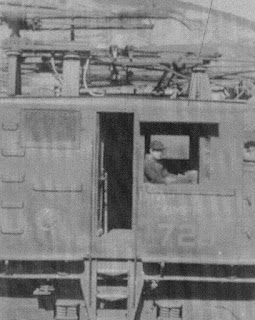
Lance on the 728 electric engine
Baseball occupied o lot of our spare time during the warm days of summer.  We played at the ice- house across from our apartment some of the time.  The rules were if you hit the ball in the open sewer the batter had to dredge it out himself.  If you could make it around the short bases without stumbling on a rock and inheriting a new scar, you were lucky indeed.
Most of the summer mornings until three in the afternoon, the kids in town were picked up by bus and transported to Copperton, three miles down the canyon where we played baseball in leagues.  We were the Frogtowners.  Not only did we have the best caps but the best team.  Our stars were the Groves “kids” and surviving them from day to day was a feat in itself.  For instance; typically we would thump, Copperfield or Carr Fork.  The score would be 100 to 3, but if you struck out- in spite of the long lead- and Frogtown had to take the field, Bob Groves would whomp you because he had to go out onto the field in the hot sun.   I’ve never figured out why the three Groves brothers, Bob, Cliff and Bill were so damned mean.  Their dad was quite rough and their mother was a tough Argyle from Spanish Fork.  Her sister was no doubt one of my best teachers. 
But there is always someone to meet your match.  The groves met their occasionally from one of the short Wops or Greeks from Highland Boy.  Black eyes were quite endemic in the canyon. 
There was always a warning from my mother when she asked us to go to the grocery store where we had to pass “Crazy Flora”, poor thing but we had to pass the Groves who pounded us with rocks. 
Tree hunting in Dry Fork
I think God got tired of them when he send a flood of mud and rocks through the back door and out the front. 
There is a mixture of good and bad in most people.  The groves though bullies were the spark plugs that got the games and activities going in which most of the neighborhood kids participated. 
At one time the three of us, Phyllis, Max and I were in casts.  Mine from showing of on the swings at Bingham Central School where I attended four years.  Max broke his arm swinging from transfer pipes in the gas yard below the apartments,  and Phyllis managed to break hers roller-skating  on the concrete deck in the back yard.
Great Depression and being poor
In fact the entire Bingham experience served as an effective tutor; make good in what you do, have hope, innovate and be a good worker, or you may have to move back and work on the “Hill” ( the generic term for Utah Copper Co.). 
Phyllis  Mom   Max   Lance and father Lance  in Midvale
By todays monetary measure, we were poor, but never in activity, home, enthusiasm and hopes for a better place.  Any family with our income level today would be considered below the poverty level.  We were not alone in our community.  Most all suffered from the lack of means.  Utah Copper was essentially closed and dad worked perhaps a day or two a week.   The nation was in a major depression and people scrimped, relying on relatives who had farms or a little to share. 
The Mormon welfare reserves were stretched to the limits but managed to help its members by distributing sacks of flour to its members.  Dad promptly returned our 50 pound sack of flour because he thought it was his responsibility to take care of his family. 
I think my dad was relatively happy in Bingham with his friends and family.  He was well developed raconteur- often reflecting back to his youth and abuse that shaped his life.



Saturday, August 13, 2011

BINGHAM A GHOST TOWN bY EUGENE

U.S. a Ghost Town
United States Mining & Refining Co.
By Eugene H. Halverson


Nothing was stirring, well maybe a mouse, the mines had closed and the people were gone.  No one to bother us the town was ours.  There was nothing we could not do or see.  The towns water tank was now our swimming hole.  Abandoned mines, buildings and equipment made a wonderful playground.  My favorite was the gun turret set on a narrow gauge circular track, complete with bullet marks and dents.  By pulling or pushing a vertical lever, we could go forward or backwards, it could travel fairly fast, and still slowly rotate so the gunman could shoot the strikers through one of several gun ports.  I played on the stumps of the giant Red Fir, some over five feet in diameter that the Mormons hauled away to Salt Lake.  I walked through the long deep trench where silver with lead surfaced, it was taken in 1863 and then became the first mine in Utah.  These and the people are my memories but my dreams are what it was like before we made such a mess the poor mountain.  Mining sucked the surface water away, springs and streams are gone as well as flowers, bushes and trees. The mountain is scared with hundreds of mine dumps,

roads, trails and junk.  The mountain still is rich with minerals that will never be mined during a time of low profits the pumps were shut off and now we have a couple of hundred miles of tunnels full of water that is to expensive to be drained. 

BINGHAM EUGENE HALVERSON'S HISTORY


GENE’S BINGHAM MEMORIES
By Gene Halverson
Our last house in Telegraph
I was born in Telegraph but I was too small to remember Telegraph this early.  I do remember Frog Town and life after that.  I remember Telegraph when we moved back a few years later.  Remember the song, “I owe my soul to the company store” well that was us.  We lived in company town, in a company house, and required to buy from a company store with high prices and poor quality.  Dad worked seven days a week, ten hours a day.  When he became too sick to do this anymore he was fired.  So one day a company truck came and loaded up our possessions and simply moved us away.  This was also during the “Great Depression” when everybody was suffering.  Our new home was now in Frog Town.  In the George Panos Apartments and I remember buying food from Chris Apostle in his store just up the street.  Hogan Dairy provided us with milk.  Everything on credit.  It took years to pay back our many bills and always felt grateful. 
I found the Zion Lutheran Church records and read about hundreds of dying or dead miners. 
My Klippiga Bergen books tells of strong young men who soon were sick and dying.

Men were dying every day because the companies refused to provide water for the drills and
water to sprinkle on the floor to rid the mine of dust.  
  
Frog Town    
Panos Apartments
We lived in the top apartment and had a climb a stairs to our living room.  The exit from the kitchen took you to the back yard and a mountain.  Below us and down the canyon a ways was the abandoned Yampa Smelter with its giant smoke stack and all kinds of walls and holes to play in.  Above this was a covered pipe-line that brought water line from Dry Fork.  This made a nice trail to walk on.  Now we had trees and a garbage dump to play in.  Cows and pigs to see and take care and watch out for the rattlesnakes.  We walked the Bingham creek, mostly called the sewer.  We played in the fine white sandy banks of the creek.  We had no idea it was the town’s sewer and the mine’s copper-water drainage ditch. We loved to dunk an iron nail in the water to make a copper one for you. 
A few years ago one of the Turner boys told me, his dad and George got quite wealthy by diverting the sewer into a garage full of tin cans they got from the garbage dump and selling the copper.
Frog Town with depot and smelter


To get to the mountain out front, we crossed the road and railroad tracks below the train depot, ice house and a few houses.  It was covered with oak brush 
and flowers.  Higher up was two large rocks to explore.  The upper rock was an entrance to a mine.  I was scared of the cave.  It was so spooky and a nightmare convinced me there was a lion in there.    I can still see him in my mind.
Lee and I watched the trains come to town, they were “steam engines” and they huffed and puffed and whistled.  We put lots of things on the tracks for them to flatten.   
kids at Panos Apartments
Lee and I had made lots of friends and learned many more mischievous ways to entertain ourselves.  Back then an inter-tube was made of real rubber made from a rubber tree.  It was red and it stretched and to us was quite valuable to us for making flippers and rubber guns.  The Grove boys loved to shoot at me with their rubber guns so I gave them a merry run.  They had the rubber bands tied in knots and it did hurt.  After I would return and began looking for the bullets they lost and now I had a rubber gun too. 
Out the corner of my eye I saw a little girl come and disappear. Was she a ghost, a fairy or an angel?  She never came back.  I’m not sure what I was looking for when I began peeking in a couple of the churches.  No one bothered me until I peeked in in the Mormon Church and when a little old lady came to the door and I ran away.  A couple of weeks later she caught me and was taken here and there and I must have liked it because a few years later I was baptized there.  I did a lot of reading and liked the stories but I did not find what I was looking for.  I was told to shun dark skin people, other churches were evil.  Well I was playing with these kids and I knew better.  My God loves all people.      
Mother liked it here and had many friends.  She smiled a lot and visited, and shared coffee, and played cards.  A refrigerator and hot water made life easier.  She had some “Tarot” cards that predicted a death, he died and she burned them. 
Frog Town 
I was too young to realize what mother and dad had to do during these hard times he did find work at the Adderley Nichols Garage pouring gas.  He suffered from bouts of pneumonia, his resistance was low he left home when Lee and I got the chicken pox or measles.  Everything had gone wrong for Dad, no work, no money and now another new baby, Paul. 
It was New Year’s Day 1936 and we were out of school and we were sledding down an alley next door into Main Street.  We were told the coast was clear so down lee and I went and that is all I remember.  Days later I woke up in the Bingham Hospital.  I was covered with sandbags so I could not move at all.  There was wires stretching my leg and another pulling another way.  There I lay for a week or a month, I don’t know.  My leg was broken and dislocated at the hip and my pelvis was damaged.  I was a mess.  Mother refused to let them amputate.  I could not walk for a year.  Lee had his face and sinuses messed up and was lucky to survive. 
We were hit by one of the Hoyne boys, he was the son of the man who fired dad.  Mr. Hoyne knew his boy drove to fast and was afraid of a law-suite so he gave dad him an outside job back in Telegraph with a company house. 
out house below US road
Back in Telegraph
Our house was a small three roomed ugly unpainted little house without access to water.  No bath tub, no sink.  Even our coal shed was down a hill and across a ditch.  Nothing convenient but we loved it after living cooped up in an apartment.  Our house was set in a curve in the road below the Giant Chief Dump, one side had a high rock cliff and the other side was Chea’s house.  One road going up Bear Gulch and the other up Galena Gulch to US.  The cliffs was a solid rock face that went from Bodmer’s to the steep Bear Gulch ditch.  I looked and looked for a way to climb up and over it.  Next thing I knew Carmela Chea had done the impossible.  Now we had a secret passage to a new playground on a forested hillside. 
We had twelve families living in the apartments and five houses so there was usually enough kids to play with.  Every one of them built on an ore dump.  There was a huge wooden cribbing under neither the apartments.  The cribbing made a home for many squirrel and chipmunks.  One day we would feed them and the next we would throw rocks at them.  So they were to wise not to trust us.

We had floods that came from snow melt and rains.  They were scary and fascinating.  At times wild animals would come wandering through.  Spring brought the flowers and birds.  Mother always had something for the little redheaded that came birds came to the kitchen window to be fed.  Winter came early with cold and snow.  Lots of snow with no place to throw it.  When the tap in the shed froze I had to carry the water home.  A yoke over my shoulders allowed me to carry two buckets at a time.  Our water came from a spring, to a tank that was piped to a tunnel.  It was so good that people came from miles around, it was famous. 
siblings with Tippy Telegraph
We needed wood for the stove.  It seems like I was always sawing or chopping wood.  We had sawhorses to saw the logs and a block too split the wood. 
Grandma’s House
I wanted to stay and explore this new home but I was sent away to Mapleton to live with grandma on her farm.  I was lonely but it was fun feeding and caring for the animals.  There was all kinds of things to do on a farm and everything was new and fascinating.  Like it or not I healed and grew strong.  Uncle Joe had cut this field of wheat with a hand scythe with cradle, a day's work on the scythe was real hard work.  I could barely lift this huge contraption but I did cut a little.  I then bound and tied the stock with a few strand of wheat, and later stacked grain side up to dry.  These standing stocks would be loaded on a horse drawn wagon and taken to the thrasher.  I could hardly wait for the thrasher and neighbors to come.  The thrasher would soon begin to growl and grown and dust would fly.  In time a large straw stack would form on one side and grains of golden wheat was being loaded in the bed of another wagon to be taken to the granary.  I loved to run my hands through the grain and chew on these grains.  Hay for the cow was planted and cut at least twice while I was there.  I remember the hen and chicks scrambling to get away from the cutter.  After drying it would be raked and loaded on a wagon.  Huge forks would pick it up and carry it into the barn.  
grandpa's barn storing hay
I loved to watch Uncle Joe milk.  He was good with a flick of his wrist would give each cat a squirt of milk right in the mouth.  I tried but never hit close to the cat.  I fed the pigs and chickens, turned the crank to separate the cream from the milk, and then make butter out of cream.  Grandma made money selling her butter.  One lady drove all the way from Salt Lake City to buy some.  Oh, how I loved the buttermilk.  We had meat, vegetables and fruit with every meal.  But no one to play with or talk with. 
farming
West of the farm was a ravine with a pond and a creek with, ducks, birds and snakes.  We called it the “Hollow”.  I loved it there.

One day we all went for a picnic up Hobble Creek where I met our double cousins.  We had two Halversons that married two Petersons.  I was bored and restless and went off by myself looking in the creek.  She said don’t look at him, catch him.  It was my Aunt Mary Halvorsen Peterson and she showed me how to fish.  I found a pole, she found a hook and string and off we went.  What a wonderful day with a wonderful lady.    
I had no idea why I was sent down to grandmas.  I thought no one loved me.  And where did these babies come from?  First there was Paul, then Vivian. 
They came and brought me home just before school was about to start.  I had missed so much school last year they decided to put in the first grade again.  School was a about a mile down the canyon and the way was steep. 

Copperfield
Copperfield road along side sewer below E Bridge
Walking from Bingham to Upper Bingham was quite an experience and dangerous.  You were walking through the main part of the mine right next to the trains, trucks, giant shovels.  If you heard a whistle you had to run to a shelter.  They were springing and blasting and rocks were falling everywhere.  Rocks were also falling from the bridges you had to walk under.  A few years later they built a mile and a quarter tunnel to walk through. 
It seems like the new boy in town gets tested.  I had many fights.  It seems like I always had a bloody nose or a lump on my head until I got the hang of it.  I even got to like fighting.  Max was taller and had a longer reach so I learned to take my lumps until I wore him out.  Then I took him down and got even.  Then he would take me home and his mother would feed us.  He was a lifelong friend.  He would go on to be quite famous.
school house
In the fourth grade I got real good in arithmetic and multiplication.  The fifth grade was with Miss Holbrook and school began to be interesting and my report card showed it. 
Beverly Barrett was “Taffy Ann” and I really do not know who or what I was.  I was happily singing away when the teacher said, “Stop” and everyone looked at me, Halverson just move your lips, “do not sing”.  I cannot carry a tune to this day.
Then we did “The Copperfield Wood-Burned Mural” and it was one of the most ambitious projects in all the 350 school-works by Utah school children in the all-Utah school arts exhibit at the Utah Arts Center in the Utah State Arts Center in Salt Lake City.  It is a ten foot by four and a half foot wood-burned mural done as a community project by the children of the fifth grade of Upper Bingham School.  Committees of the fifth grade were chosen to visit various buildings in Upper Bingham, Included in the mural was the First Utah Copper Mine Office behind it was the Mine itself with its levels and operations.  The center piece was the large figure of a miner, the mural accurately shows stores, boarding houses, schools, mine buildings and other familiar scene to Bingham residents.  The children of the Upper Bingham School have developed the mural until it is representative of life of life in this community.  
Jap Camp
We had a tall Japanese was our main artist.  He was very talented and he drew the center piece, a miner with a pick and a shovel.  Our mural look so real.  Isabell Rose drew and burnt the Copperfield side of the tunnel. Our school was in the lower right-hand corner.  I remember sitting on the floor burning and shading it. 
The companies divided Copperfield by national and racial housing.  Whites lived on Main Street in brick houses, Mexicans in Dinkeyville, Greek Camp for single men and Jap Camp.  I loved to go with Jackie Myaki to bathe in their large hot tubs.  And before the war they had a school to teach the kids how to draw and write the Japanese language.  This extra help made them very good students in our school.  It was a shame to see them close these schools after the war.  But even before if any child spoke any language other than English they were punished.  The many nationalities, cultures, customs, dances, and food made Bingham what it was.  I loved everything about what we had.  I am afraid it is lost and gone forever. 
Copperfield and Dinkeyville

besides you, who have you told, what about your parents?  Then the two of us sat down to talk.  He didn’t tell me how he found this body of ore (silver and lead, whatever) but I believe he went down to bedrock for gold and found it by accident.  He asked me to keep quite or he would be sent away.  So, I promised.    He worked with a pick, shovel and wheelbarrow.  He mixed waste dirt with his ore to fool the US Mine who he was leasing from.  If they even had an idea how rich a claim he had they would have shut him down.  One day he retired and went to Salt Lake to live.
Copperfield 4th of July

At the bottom of a wash below the apartments was a flat sandy place for games.  Buck Leyba would bring up a bunch of kids from Dinkeyville and we would play either football or baseball depending on what kind of ball we had.  Below this was the cocoa dirt we played in.  The dirt was the remains left from an old stamp mill and concentrator.
One day a dump truck stopped on the road and dumped about seven powder boxes of glass negatives that had been stored in a warehouse somewhere. They would have been worth thousands of dollars today.  I saved about a dozen years until dad put them in the garbage dump along with my collection of carbide lamps and brass candle holders.

We lived in a dangerous world.  There were working mines and abandoned mines right amongst the houses.  Two men went in a tunnel in Dinkeyville and died of poison air.  It was a quick way through the mountain to Yosemite.  I went through it but never with a flashlight.  There were mine shafts, holes where the surface caved into a mine.  I lost a dog and the Ivies lost a horse.  Two boys were found dead in a ventilation shaft. 
Old Telegraph Mine
Then dynamite and carbide could be found in many tunnels.  I knew a few boys who lost a finger or two playing with dynamite caps.  Primer cord explodes just like the caps.  Bombs were made from carbide.  Some even set off dynamite. 

Flying
There wasn’t much for a crippled boy to do and I was bored.  Mother noticed this and gave me a balsa wood airplane kit.  The more I made the better I got.  The first were proper driven, then I went into gliders.  Then in wings.  Now I needed to make a big one.  I soon found myself in a place I should not be and took an armful of ¼” by 1 ½’ by 14 foot fir strips from US Carpenter shop.  It took a while to build and a while before I tried to fly it.    Kids came in from Dinkeyville and Copperfield to watch me fly it.  A half hour later we were up on the Giant Chief Dump and tying a 25 pound bearing cap to the nose.  Everything was perfect, a good rising wind coming up the dump and all I had to do is find the right balance and send it away.  On the third attempt I was lifted off the ground and flying away.  They told me I was still running even when my feet was ten feet off the ground.  I was in trouble and knew it.  If I dropped off now I would be dead, but when I got to the end of the dump I was twenty feet in the air and going faster every second.  Well I 
Karl John
dropped off before the hundred foot death drop.  I ended up with all kinds of cuts and bruises and bleeding in many places.  All the time trying to see my giant wing.  I was looking down the canyon when it went straight up higher than the dump and then see-sawed its way down into Marsell Chea’s garage.  The bearing cap busted its way into the top of the garage leaving the poor wing for us to take away.  He never asked anyone about the hole we knocked in his garage or the bearing cap inside so we came out of hiding.  He must have known but took it with a smile.  We never even told mother what we were up too.
Exploring the Mountains
I got a brand new 22 rifle for Christmas, a pocket knife, a potato and a few matches and Tippy a Rat Terrier grandpa gave me.  He was quite a hunter and furnished me with many meals.  I ate squirrels, porcupines and birds with my potato.  A time or two I didn’t even come home at night.  When some mother was looking for a child they’d call and told them if they were with Lee they’d be alright.  These were the best years of my life. 
We even cooked grasshoppers.  If an Indian ate it we could too.  You ever tried stinging nettle?  Boil it a couple of times and it was tasty. 
Snow was melting and the water was running and I was there panning for gold.  I followed Alvin Cole to a flat above my house.  I was not the best but I did find gold. 
Our house at the head of Bear and Galena Gulch was the starting place for most all trails into the mountains.  From these mountains I could see Salt Lake, Tooele and Lehi.  What a place and time to live. 
Telegraph being demolished
The Black Rock Trail
We had the coldest, sweetest water in the water tunnel next to Bodmer’s house?  The Black Rock Trail started right there.  There were “Skinks” there they were half snake and half lizard.  Long and skinny as a pencil.  Dark brown with tan corners and bright blue tail.  These were not the common blue belly lizards. 
From there we walked over the mountain to “Hawk Rock”. In late summer we would find these crazy star shaped “Puff balls” that exploded when you stomped on them, this would send these brownish/purplish powder spores all over your ankles.  They are actually a very poisonous mushroom the 6/8 stars are the hard outer cover of the ball that flattens leaving a tannish ball holding the spores.  I now know them as the Earth Star Puff Ball or the Devil’s snuff Box. 
The last stop on this trail was down to “Eagle Rock” sitting above the old Bishop Mine in Yosemite Gulch, we could see Lark and all of Salt Lake Valley from here.  The mine head frame and building were still in use, it pulled cars up from the shaft going deep down in the mountain.  We had a choice of walking back over the mountain or a tunnel Dinkeyville?  The tunnel was about a mile long with shaft that was very dangerous to tip toe past.  It ended near Carter’s old house near an old trail to Telegraph, this used to be the “Old Holden mule railroad”.
The Bear Gulch/Queen/Butterfield Trail
Copperfield, Telegraph, US road
Take a left just behind my house on the road to Queen at the top of Telegraph, after a steep climb the road levels out where a cement dam was used to save the creek water for “gold mining”.  Every time I panned out a nice piece of gold, Alvin Cole would say, “That’s a good boy, here put it in my bottle”.  Across creek was the most beautiful grove of ancient old Maple trees and the only lawn I ever knew?  It was a camping and picnicking that I used many times.  A half mile latter you past the “Big Tree”.  I remember the spring there before the arsenic got in it?  This was an old Indian Camp where I found many arrowheads and flint knives here.  Can anyone remember Jack Ass Gulch with all the old Quaken Aspen trees, this was the right fork?  The center road went to a couple of mines still being worked, I remember it as Bear Gulch.  By staying on the main road about a mile or two farther took you over the mountain to the town of Queen. I remember when Queen housed at least several families and a boarding house for the single men.  Travelling below the big Queen Mine Dump to the first turn you would leave the road and make short climb to the mines water line that went from Butterfield to Queen.  Then traversed the tops of Butterfield Canyon until we got to the Boy Scout Camp.  I remember the building with its big fireplace where Lee and I spent a snowy night with one blanket.  There were four of us to start with but the others left sometime in the dark.
Telegraph above Copperfield
This was a wide area at the junction of three canyons.  Each canyon had a creek and many springs.  It was also the site of an old Indian Camp.  I found quite of an assortment of arrow heads.  When I was young the creek was planted with fish, when we were hungry we would catch them with rocks or clubs and roast them on a stick.  In the spring we would look for Indian Potatoes, a small eatable bulbs.  They were first green plants to show up as the snow melted. 
The Bear Gulch Middle Canyon Trail
Starting at the back of my house in Telegraph you would walk to the Queen Ridge leaving the road for a trail that headed up toward Sun Shine Peak, to the left you could look at Queen far below.  At the right was Doctor Frazier’s ski run and ski jump.  I skied it and remember it well.  Going up put you high above the “Silver Shield Mine and the US Road.  A little higher and above Silver Shield was the stumps trees of an ancient forest called “The Big Grove.  It was clear cut to build the Mormon Tabernacle.  Did anyone besides me ever go over and lay on the huge 5/6 foot diameter stumps.  A half a mile father up the trail leveled off a mile or so above Butterfield, passing through two large groves of Quaking Aspen.  I remember this part of the trail because of the many Horny Toads found there.  You see the Butterfield-Middle Canyon Pass a half mile below where you would go over the pass to another to a spring above the Highland Boy water tunnel and on down to the tunnel.  At times there would be kids my age who had arrived here from Highland Boy.  These were my first friend I knew from Highland Boy.   
The US/Galena/Bingham Gulch Road
2 mile Telegraph to US road

 The first half mile above my house was quite steep until you reached and crossed this huge air pipe 10 inches in diameter, coming from Copperfield to the US Mine.  Did any of you try to slide down it too?  Once was enough for me too. The road was mostly level for the next two miles to the US Town and Mine.  The Utah Copper Dump on the right went straight to the US.  The Silver Shield Mine had a dry-house for their workers too shower but the water was full of arsenic and tasted bitter but it was hot and Lee loved it.  
I remembers when US was full of houses and people, I had many friends there?  Lorraine, Blackie Clinton’s daughter said, “In the winter time when the roads were closed, they went down a mine shaft through a tunnel to the Copperfield school. 
Freeman Gulch
Above the US Mine there was a railroad car that was built to kill the strikers.  It was a self-propelled round metal gun turret with six holes manned by six men.  As it rolled along on this circular railroad it rotated giving each man a shot.  When the people moved away we tore the roof off the town’s water tank and swam in it.  It was so icy cold and deep but it was clean. I remember when our 5th grade class hiked above the US and then over the mountain and looked into Highland Boy.  There we went into a dark old mine until it was too dark to see.  It was spooky enough before we heard the bear.  But it was just our principal growling and playing games with our minds,. 
The “Water Falls Trail Freeman Gulch
 As a kid I hiked all over the hills in Bingham.  My buddies at that time included Art Bentley, Teddy Allen and Floyd Timothy.  We had a favorite place we called “waterfalls”; it was a real pretty spot with a nice stream and a pond.  We made rafts and poled around the pond.  The water was so cold we didn’t swim unless we fell off the raft.  The water falls and pond was in Freeman Canyon just over the B&G railroad.
The Markham’s Trail
Markham Canyon bridge before D Dump
Markham Gulch was a very long canyon heading straight toward Markham Peak.  It produced a lot of springs that gathered together to make a very large stream even in the late summer.  It was a wonderful canyon.  It was full of Maple trees. Quaken Aspen. Pine trees, Oak and Mahogany trees.  The higher you went the more primitive it became.  This creek here in this canyon was as large as the Butterfield Canyon creek that had fish in it.  It was another clear water pond made by the waste dump damn. 
Winter Time
We played in the snow did a lot of sledding.  We could ride over a mile or so with no problems.  We were at the end of the road and the cars were mostly parked and snowed in.  But one day I noticed ski tracks and we were too poor to buy me some.  So I went behind a Copperfield store broke up a big barrel and made a pair of skis.  I followed the ski tracks to the top of Bear Gulch and found a much used ski run and jump.  I didn’t have much trouble with the run but I fell down on every jump. 
I was skiing on Doctor Frazer’s run and jump.  He was getting ready to go to the Anarchic with Admiral Byrd.
The snow was melting here and the Lark side of the mountain had lots of snow.  Now I had to get my brother to come with me.  After a short walk over a saddle off we went.  We skied a mile or so almost to the bottom when Lee stopped and kicked off his skis.  Down he went almost out of sight and he couldn’t move.  The snow was too soft and he needed help.  Well I got him out and found a ridge to go home on.  It was cold and Lee was tired and almost frozen.  I was breaking trail and never noticed Lee was no longer there.  He wanted to go to sleep and it was a battle to get him moving.  I got him home but I lost a skiing partner.

Changing Schools
Latest Copperfield school
Our principal Mr. Atwood left us to manage a California school.  I still have his post card with a one cent stamp on it.  Mr. Nelson was now our teacher and principal and we did many things.  We had a long “May Day” from school, through Telegraph, on up over the top of US to look over the mountain.  We were well over 10,000 feet and could see both sides of the mountain. 
One field trip we went to the University of Utah to see experiments with electricity, vacuums and other interesting things.   
Another field trip was to the Magna Mills to learn how they made ore in to copper.  Well we did learn a lot but managed to get in trouble.  As we were passing by some machines in the shop there was a box full of silver bars, I asked the man are those silver?  Yep, put a couple in your pocket, and we each took one.  They were too big and shiny to hide and all the men were laughing.  When we went to get on the bus, the teachers spotted us and we had to give them back.  The foreman even laughed at us.  He told us that they were Babbitt bars not silver. 
We got our first radio and at first we would sit down and listen to some funny stories; I Love a Mystery, Tarzan, Fiber Magee and Moly, Kingfish etc.  Then the Second World War began.  War in Europe, war in China and then Finland was fighting Russia.  We still had family in Finland and we were quite concerned.  Now we were tuned into the wars.  China was in a losing war.  Germany had taken most of Europe and was losing in Russia. Finland had stopped Russia at its border.  But it was on the other side of the world. 
The war got closer when Bob Burke was killed when his ship was sunk by a German submarine.
Harvey Halverson & Marcell Chea
Telegraph
Then in 1941 war came to us and we were angry.  Bingham boys began enlisting, even in my class Max Salazar was 13 when he enlisted, 14 when his ship was sunk and wounded, then he received a presidential citation for rescuing his commanding officer, who was trapped in burning oil.  Honorably discharged at 15, rejoined and was sunk again, lost for weeks on an island, and discharged again. 
Graduation classes for the next few years several years had very few boys left. 
War took so many men into the service boys and girls were hired. 

I hired out in 1944.  Worked on the track-gang.  At times the gangs were all young boys.  I first worked on Bicycle Gus’s gang.  He was a little old man with short legs.  He peddled down the ties so fast he was hard to keep up with.  He was Greek from the old country and I liked him very much.  He had quite an accent and we all tried to mimic his speech.  We learned how to cut rails with chisel and hammer.  Drill holes in rails.  We were the only gang at the mine who could do this.  I learned a lot from him. 
Then I was a Dump man.  Telling the brakeman where to dump his train.  When this berm when it became long enough it was flattened and the track moved out for another berm. 
Jack Whitely noticed me and I was given a train to work with.  I was now a brake man who hanging on the lead car going to the dump.  I learned all the tricks to keep them running, and putting them back on track.  A couple of friends were killed so I moved on.  I remember some funny times with “Wild Bill” and we were helping him so he could eventually retire.  He was a good man in his day but today he was “blind as a bat”.  Signals were never seen.  The brakeman stopped the train by kicking the tail-hose.  Gordon Hickman was riding the end and signaling like crazy.  He jumped and watched his train run to the end of the track and over the hill.
Mormon Church kids
I tried the Shovel Department for the higher pay and but had my fill of the danger and nasty treatment.  Well the nasty old Runner was killed a year or two later.
I bid on the machine shops to work there.  I helped Lewy Ballamis and it was fun.  He was the only real boilermaker left at the mine and every day was a surprise when one of those old steamers would come in.  More than once we would rake the fire from the boiler and the grate was still red.  We covered the grate and I would cover Lew with wet rags then he would climb in and tighten a stay-bolt or something.  I loved that old man. 


Then in 1948 the US Mine took our house and tore it down.  We moved to West Jordan and my story ends.  


Telegraph in winter